
)
May 18, 2026
The Hermès Chypre: How a Cypriot-Inspired Sandal Became the Gulf Man's Status Piece
The Hermès Chypre: How a Cypriot-Inspired Sandal Became the Gulf Man's Status Piece
There is a Friday in Dubai where you can read every man at brunch by his footwear.
The kandura is the constant. Crisp white, no shifting. The watch tells you about money but not about taste. The cufflinks tell you about effort. But the sandals tell you everything else. And in the last three years, at Roberto's and at Cipriani and around the pool at the Bulgari Resort, one sandal has done the heaviest cultural work in the Gulf men's wardrobe.
The Hermès Chypre.
Watch closely and you start to notice the colours. The Etoupe greige worn by the businessman who has bought every Hermès tie in the boutique. The Bleu Jean on the Saudi cousin in town for the weekend. The Bleu Canard on the Emirati twenty-something who knows exactly what he is doing. The Noir on the regular who refuses to overthink. The shearling lined Sherling Ecru on someone who arrived from Riyadh and decided to keep them on indoors. Nobody is showing logos. Nobody needs to. The Chypre is the loudest quiet sandal in the world right now, and the Gulf adopted it harder and faster than anywhere else on earth.
Here is why, and here is how to buy one in the UAE.
What a Chypre actually is
Start with the name. Chypre is the French word for Cyprus, the Mediterranean island where Aphrodite is said to have emerged from the sea. Hermès' own copy describes the sandal as inspired by "the island that is home to Aphrodite's waterfall, where the water promises eternal youth." That is the brand mythology speaking. The practical reality is a calfskin sandal made in Italy, with a calfskin insole, a goatskin lining, and an anatomical rubber sole. Hermès calls it a techno-sandal. That word is doing a specific job. It signals that this is not a beach slipper or a flip flop dressed up for the city. It is a sandal engineered to be worn all day, with a properly shaped rubber sole that absorbs surface impact rather than slapping back at it.
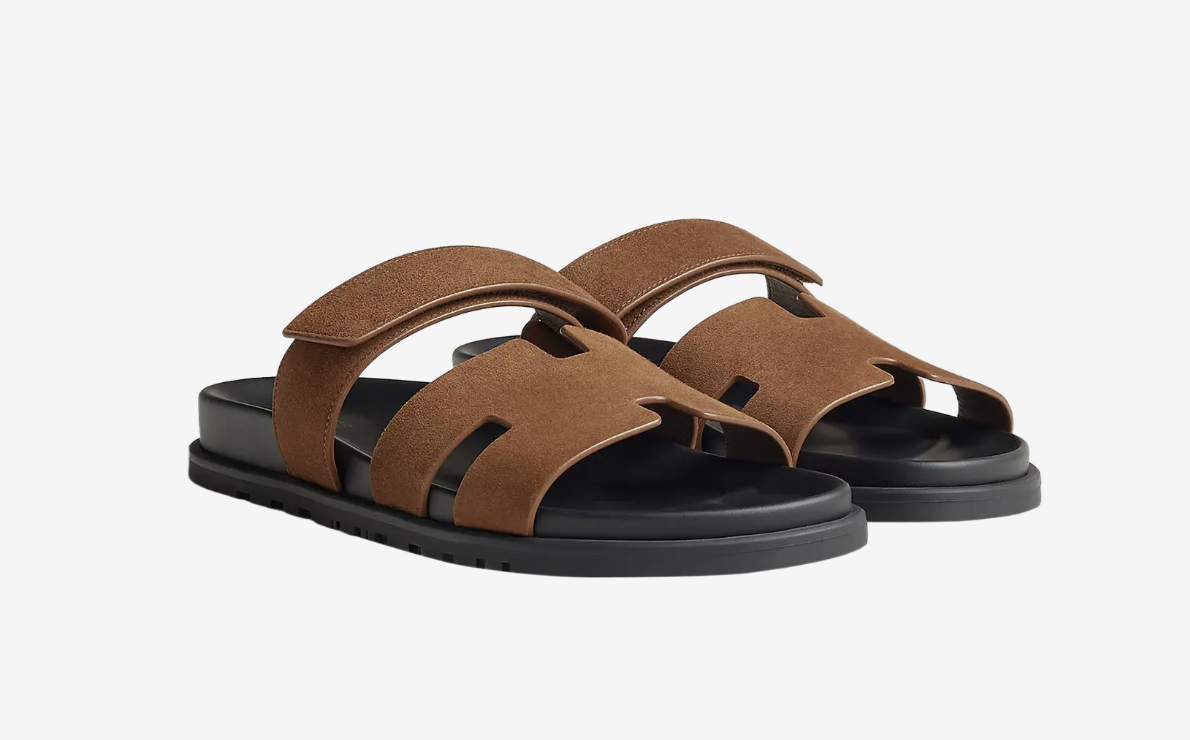
The construction is what separates the Chypre from every other open-toe shoe in the Hermès range. The upper has two straps, one across the toes and one across the instep, with an adjustable buckle on the side that lets the wearer dial the fit precisely. The toe is open. The heel is open. But the foot is locked in. It is the difference between a sandal you put on to walk from the pool to the bar and a sandal you wear from a morning meeting to dinner.
The full Hermès footwear range in the UAE includes the Oran, the Oasis, the Izmir, the Bouncing sneaker, the Game, the Quick, and the Day mule, but the Chypre is the one that has eaten the cultural oxygen in the Gulf over the last three summers. The reasons are worth understanding before you commit to a pair.
Why the Gulf adopted the Chypre
Three things happened at the same time, and the Chypre landed at the centre of all three.
The first was the kandura match. Gulf men in their thirties and forties have been moving away from closed leather loafers on hot summer days for some time, but the alternatives were limited. Standard sandals read as too casual. Most luxury slip-ons looked like they belonged at a yacht club rather than a business lunch. The Chypre solved the problem because the proportions are clean enough to read as formal under a kandura, the construction is substantial enough to feel like a proper shoe, and the open toe handles the Gulf summer without compromise. Worn with a fresh white kandura, ankles bare, the Chypre is the most Gulf-correct piece of luxury footwear made anywhere in the world.
The second was the quiet luxury shift. Logo driven status pieces became something Gulf men actively wanted to avoid as their wardrobes matured. The Chypre carries no visible logo on the upper. The H is not stamped across the strap the way it is on certain Hermès belt buckles. The only Hermès signal sits on the sole, where the leather lining and the stamped imprint can be seen only when the wearer crosses his legs. Everything else is leather, colour, and silhouette. To the wrong eye it looks like a thoughtful sandal. To the right eye it is unmistakable. That asymmetry is exactly what Gulf men in this tier are buying.
The third was the colour system. Hermès rotates Chypre colourways across seasonal drops, and the colour code became its own language. Knowing what is in stock and what is rare functions as a kind of insider currency. A black Chypre is the safe and obvious move. A Bleu Canard or a Bleu Jean or a Gris Nuage is the read that the wearer pays attention.
The colour code, decoded
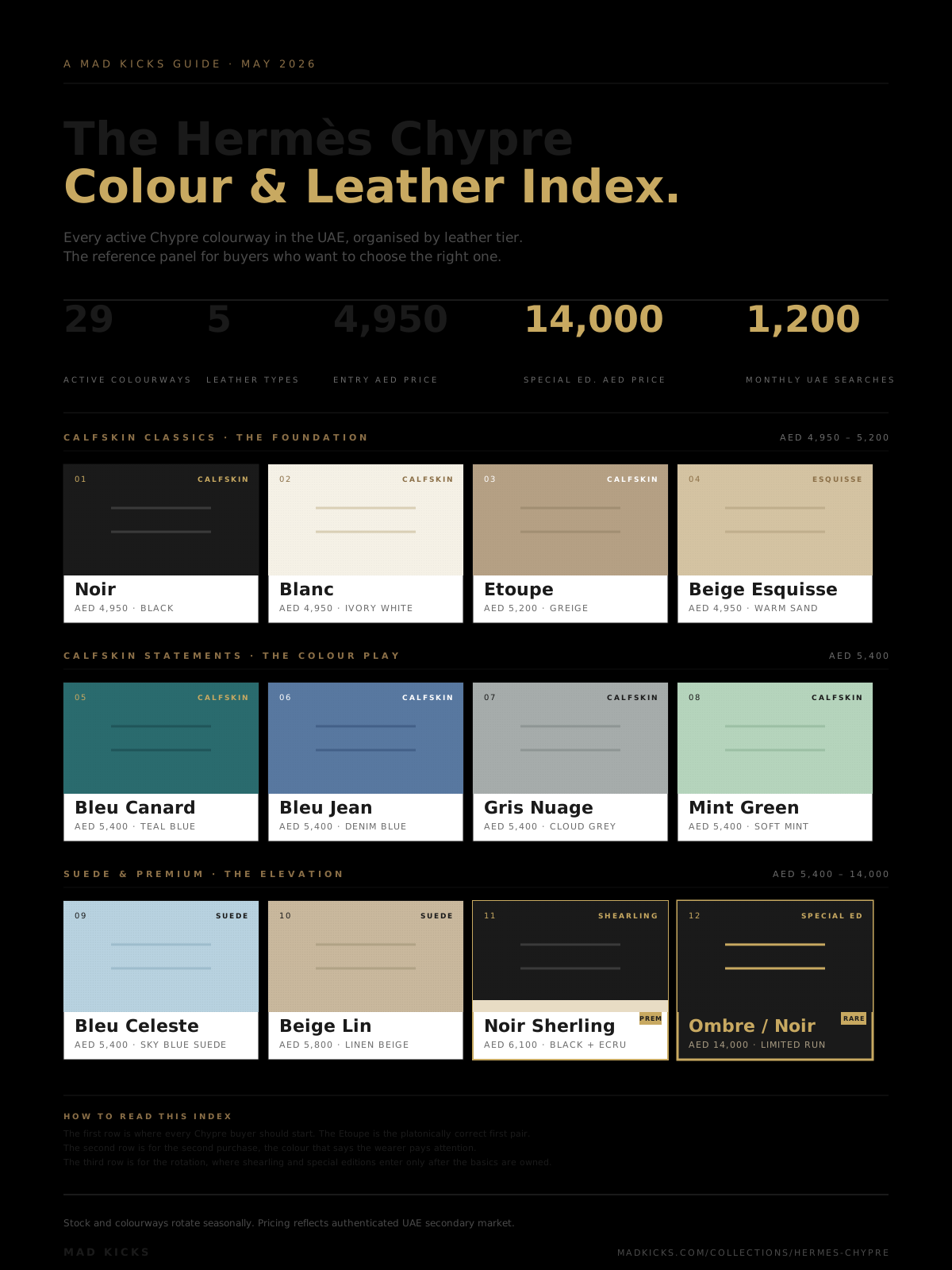
The Chypre's colour palette is where the actual decisions get made. A short tour through the active Chypre colourways in the UAE is worth running through before you buy, because each one signals a different version of taste.
The Noir is the entry. A black calfskin Chypre is the safest first Hermès sandal anyone can own, and the one that pairs with the widest range of looks across both formal and casual wear. It is the sandal you wear when you do not want the sandal to be the conversation.
The Blanc is the second safest entry. A white calfskin Chypre signals summer commitment and pairs particularly well with cream and beige kanduras. It also shows wear faster than any other colour in the lineup, which is part of the appeal for the buyer who replaces them seasonally and treats the year-on-year refresh as part of the cost of ownership.
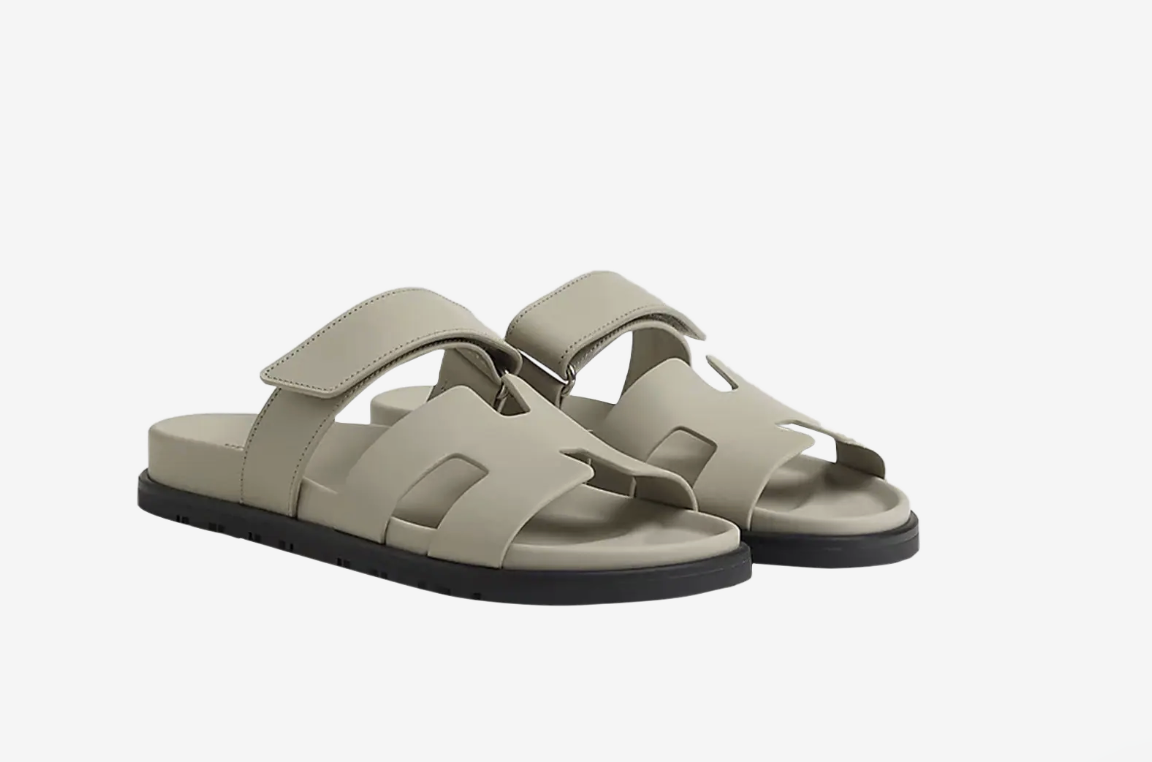
The Etoupe is where things start getting interesting. Etoupe is the Hermès greige, sitting between dove grey and warm sand, and it functions as the quiet luxury wardrobe's universal donor. It pairs with white, with cream, with khaki, with navy, with off-white linen. The Etoupe calfskin Chypre is in many ways the platonically correct Chypre for the Gulf male wardrobe. If you are buying your first pair and you want a colour that will outlast trends and pair with every kandura in your wardrobe, this is the one.
The Bleu Canard is the move for the buyer who wants the conversation. Canard is teal, a saturated blue green that the Hermès dye houses have made one of their signature tones across leather goods. A Bleu Canard Chypre under a white kandura at brunch is one of the cleanest looks a man can put together in the Gulf. The colour gives just enough contrast to read as deliberate without crossing into loud.
The Bleu Jean is the most Friday-morning casual of the blue colourways. Worn with white linen trousers and a soft cotton shirt, the Bleu Jean Chypre is the weekend uniform of a specific kind of Gulf man who has stopped needing to prove anything.
The Bleu Celeste suede is the late-afternoon move. Sky blue, in suede rather than calfskin, it reads softer and more relaxed than any of the calfskin variants. Suede adds a textural dimension that calfskin cannot, and the Bleu Celeste in particular is one of the most photographed Chypre colourways on Gulf Instagram.
The Gris Nuage is the discreet choice. Cloud grey, neither warm nor cold, it is the colour for the buyer who has already owned a Noir and an Etoupe and wants something with a quieter signature.
Beyond the calfskin standards sit the special variants. The Noir Sherling Ecru is the shearling lined winter Chypre, designed for the buyer who wears them indoors in the cooler months in Riyadh and Dubai. Shearling Chypres are a specific marker of the buyer who knows the full Hermès catalogue rather than just the obvious entries.
At the very top of the price ladder, the Chypre Sandals Ombre/Noir Special Edition sits at AED 14,000, which is more than double the standard Chypre price. The special editions exist because Hermès produces limited runs in collaboration with specific artisans or on specific themes, and they function the way limited edition Birkins function for the bag market. They are not for the first time buyer. They are for the collector who already owns three or four Chypres and wants the one that will not show up at the same brunch table.
The leather hierarchy
Five materials run across the Chypre lineup, and the price changes accordingly.
Standard calfskin is the entry, the most common, and the cleanest construction. Pricing in the UAE secondary market sits around AED 4,950 for the core colourways. Calfskin Chypres are what most buyers should start with.
Suede is the next tier. Suede adds texture and tonal depth that calfskin cannot, and the suede variants land in the AED 5,400 to 5,800 range. The trade off of suede in the Gulf climate is that it picks up dust faster and is harder to clean, which is the cost of the visual upgrade.
Esquisse leather is a specific Hermès process where the leather receives a brushed treatment that gives a soft, slightly clouded finish. The Esquisse Chypres land in the same price range as suede and read closer to suede than to standard calfskin.
Shearling lined Chypres carry a meaningful premium, sitting at AED 6,100 for the Noir Sherling Ecru. The shearling lining is the differentiator and shifts the use case from outdoor sandal to indoor-outdoor luxury house shoe.
Exotic skin Chypres exist but are rare in retail and the secondary market. Crocodile and alligator variants run several multiples of the standard price and are typically allocated through Hermès' boutique network to existing top-tier clients rather than appearing on resale.
Men's or women's, and how to think about sizing
The Chypre lives officially in the Hermès men's line. The URL path on Hermès' own website puts it under men's sandals, the Aphrodite brand mythology notwithstanding. But women wear Chypres at scale, particularly the smaller sizes in the cleaner colourways. The Bella Hadid and Hailey Bieber posts that pushed the Chypre into the global Instagram conversation in 2022 and 2023 were women in men's-sized Chypres, intentionally oversized in the calfskin classics.
For sizing, Hermès recommends staying with your standard EU size or moving up half a size if you have a high instep. The adjustable strap construction means the Chypre is more forgiving than the Oran in terms of foot width, but the toe box is fitted, so genuinely wide feet often size up a half rather than buying their standard.
Gulf men who own multiple pairs often size their formal pairs precisely and their casual pairs a half size up for a slightly relaxed fit. That is a stylistic choice rather than a sizing rule.
The Chypre versus the Oran, settled
This question comes up before every first Hermès sandal purchase, and the answer depends on what the buyer actually wants.
The Oran is the older sandal. Single strap, prominent H cutout, slim profile, flat construction. It reads as classically elegant in a way that the Chypre does not. The Oran is the sandal you wear to a beach club lunch, to a yacht weekend, to the pool. It is closer to the original Hermès sandal aesthetic and skews more feminine in its global wear pattern.
The Chypre is the contemporary sandal. Multi-strap, no visible H on the upper, thicker construction, more substantial footprint on the ground. It reads as a proper shoe with the toe and heel happening to be open. The Chypre is what you wear from breakfast to a meeting to brunch to a sundowner. It is the sandal that absorbed the role the loafer used to occupy in Gulf summer wardrobes.
For a Gulf man choosing his first pair, the Chypre is almost always the right answer. For a Gulf woman choosing her first pair, both work, and the choice is mostly about whether she wants the slim profile of the Oran or the broader, more substantial Chypre stance. For the buyer who wants the closed-toe sneaker version of the same quiet luxury Hermès logic, the Hermès Bouncing sneaker range is the natural neighbour.
Buying in the UAE
The Hermès boutique distribution model in the UAE works the way it works everywhere else, which is that walking into the Mall of the Emirates Hermès or the Dubai Mall Hermès and asking for a specific Chypre colourway and size is a slow process. Stock is allocated globally and rotated seasonally. Specific colours come and go. The Bleu Canard you saw on Instagram last week is rarely sitting on the shelf the day you arrive. Building the kind of relationship with a Hermès sales associate that gets you on the right call lists takes years and significant non-Chypre purchases first.
The verified secondary market is the practical alternative for buyers who want a specific colour and size now rather than over the next twelve months. Authentication is the whole game. Hermès does not run a third party authentication service the way certain other luxury houses partially do, so buyer-side trust depends on the dealer's authentication process. The leather grain, the stitching pattern, the embossed Hermès logo on the sole, the hardware finish on the buckle, the consistency of the dust bag and orange box packaging, every detail is checked before a Chypre lands in inventory.
The physical Dubai store locations carry the full active Chypre lineup for in person fitting, which is the only way to handle the size question properly. The Chypre fits differently across calfskin, suede, and shearling variants, and the same EU size can wear half a size off depending on which leather you choose.
How to wear a Chypre in Dubai
There is a wear pattern that works across the Gulf male wardrobe.
With a kandura, the Chypre disappears into the look correctly when the colour aligns with the kandura's accent details. A white kandura with off-white embroidery pairs with Etoupe, Blanc, Beige Esquisse, or Gris Nuage. A cream kandura with brown accent threading pairs with brown leather or Beige Esquisse. The Chypre's job here is to extend the kandura's tonal logic into the footwear rather than to interrupt it.
With western casual wear, the Chypre handles linen trousers and a soft cotton shirt better than any other luxury sandal in production. The proportions are right. A Bleu Jean Chypre with white linen and a faded blue cotton shirt is the Gulf weekend uniform of the man who has stopped trying.
The Chypre does not pair well with formal western tailoring. Suits and Chypres are not a conversation. Closed leather is still correct for the boardroom.
The pricing reality
Hermès retails Chypres at the boutique starting at roughly USD 870 for the standard calfskin variants, climbing through USD 1,100 to 1,400 for the suede and Esquisse, and well beyond AED 14,000 for the special editions. Boutique stock in the UAE is inconsistent and seasonal.
The secondary market in the UAE prices the Chypre at AED 4,950 for the core calfskin colourways, AED 5,400 to 5,800 for the suede and Esquisse variants, AED 6,100 for the shearling, and up to AED 14,000 for the special editions. The premium over Hermès boutique retail reflects three things: the cost of immediate access, the cost of authentication and verified packaging, and the cost of the colour and size combination you actually want rather than the one the boutique has in stock today.
For the buyer who has tried to get a specific Chypre colour through the boutique route and waited eight months on a call list, the secondary market is not a premium. It is the only way to actually buy the shoe you wanted.
The bigger thing
The Chypre is doing something specific in the Gulf right now that is worth naming. It is one of the small group of luxury products that have successfully crossed the line between cultural and commercial. A Patek Nautilus does that. A Birkin does that. A pair of Chypres does that, at a vastly lower price tier, which is why the sandal has become accessible to a much wider Gulf male audience than the watches and bags ever were.
The status signal here is not about the money. The Chypre at AED 5,000 sits well below the cost of any watch worth discussing. The signal is about knowing. Knowing the right colour for the right kandura. Knowing that the Etoupe goes with everything and the Bleu Canard goes with attention. Knowing that the special editions exist and which one you would buy if your second pair turned into your fourth. Knowing the boutique is not where you actually source them.
That knowledge is the actual luxury. The sandal is the receipt.
If you are buying your first pair, the calfskin Etoupe is the answer. If you are building a Chypre rotation, you add Noir, Blanc, and one statement colour. If you are committing to the full collection, the shearling and the special editions come in. The men's Chypre selection across every active colourway is more interesting than most outsiders realise. The Gulf men who have spent the last three summers wearing Chypres at brunch have already worked all of this out.
The rest of the world is still catching up.
Tala Tareq
Content & Blog Writer
Share
Explore More


Don't miss out on the latest.
Sign up to get first access to our sales, new arrivals, exclusive events, industry news - and so much more.